Monday, November 2, 2015

How Thanksgiving Became a National Holiday


Hello again everyone!  I'm Susan Morrow from Keep 'em Thinking!  I can't believe it's November already.  On the fourth Thursday in November, millions of Americans gather around a table to celebrate Thanksgiving, but it was not always that way.  Here is the rest of  the story…

     In the 1820’s, Thanksgiving was all but forgotten in most of the United States.  Each state had its own appointed day of Thanksgiving, but the only states that really observed the holiday were the New England states.  The future of Thanksgiving looked bleak and dim, but thanks to the tenacity and persistence of one incredible woman, Thanksgiving was reborn!
    
Sarah Hale lived in Boston, Massachusetts during the1800’s.  She led a happy life, but when her husband David died, Sarah was so devastated, she wore black clothing for the rest of her life.  Suddenly, Sarah was a single mother of five children. But, Sarah was determined and smart.  To support her family, she decided to use her talent with words to write books and poems. Her most famous poem is Mary Had a Little Lamb. 
     Sarah’s books and poems were very popular, and she became the first female  editor of  a magazine, Lady’s Book Magazine, which was also the most successful women’s magazine of that  time.  Each month, Sarah wrote an opinion piece in the magazine.  Her opinions mattered, and people followed her advice.  She wrote about things such as slavery, parenting, the importance of play and exercise for children, and education for women. 
Thanksgiving was a holiday that was very important to Sarah.  She believed that Thanksgiving should be celebrated by everyone, and each year she wrote an article in her magazine about the importance of setting aside the fourth Thursday in November as a national day of thanksgiving.  In her magazine articles, Sarah suggested foods such as turkey, and pumpkin pie to be served at the dinner.  Soon, more and more families across the country were celebrating Thanksgiving, but that wasn’t good enough for Sarah!  She wanted Thanksgiving to be declared a national holiday.
Sarah believed in the power of the pen, so she began a letter writing campaign. She wrote to governors and other politicians, military leaders, and even missionaries soliciting their support in observing Thanksgiving.   In 1849, Sarah decided to write to the president asking him  to declare Thanksgiving a national holiday.  Zachary Taylor, the president at that time, declined her request, along with the next three presidents- Millard Fillmore, Franklin Pierce, and James Buchanan.  Each time a president said no, Sarah became even more determined. 
In 1863, Abraham Lincoln was president of the United States, and the North and South were at war.  Sarah felt that the country should be united and that declaring a national day of Thanksgiving was one way to demonstrate national unity.  She wrote a letter to President Lincoln on September 3, 1863, and on October 3rd, Lincoln issued a proclamation making the last Thursday in November a national day of thanks.  After 15 years, hundreds of letters, and five presidents, Sarah had achieved her goal.  Thanks to her determination, persistence, and the power of the pen, Sarah became known as the woman who saved Thanksgiving.
I use two wonderful picture books about Sarah Hale each November to teach the history of how Thanksgiving became a national holiday.  They are Sarah Gives Thanks by Mike Allegra, and Thank You, Sarah  by Laurie Halse Anderson.  Both books document Sarah's persistence and determination. I teach about mindset in my classroom and Sarah Hale is a fabulous example of a woman with a growth mindset.  She didn't give up even after numerous failures.    

 
There are a number of online resources you can use along with these two picture books to learn about Sarah Hale and the history of the modern day Thanksgiving.  Click on any of the links below to get to the resources.
Proclamation of Thanksgiving: Collected Works of Abraham Lincoln
When is Thanksgiving Again? Wise Guide November 2002
L.L. Doty to Sarah J. Hale, Wednesday, October 3, 1860 (Thanksgiving) American Memory
 
I have created a unit on Sarah Hale, which you can purchase on my Teachers Pay Teacher's Store.  Click on the picture below to take you to the site.
https://www.teacherspayteachers.com/Product/Sarah-Hale-Saves-Thanksgiving-Literature-Guide-964813
This unit is filled with higher level thinking questions and activities.  One of my favorite activities to have my students to complete is an I AM poem about Sarah Hale.    Click on the collage below to get a free copy of the I Am Poem.

Sarah Hale I Am Poem Freebie

I hope you and your students enjoy learning about Sarah Hale!  Until next time, remember to always... Keep 'em Thinking!


Wednesday, October 28, 2015

Addition with Regrouping Using Sticky Notes

Hi there!  It's Hannah from The Classroom Key.  All second grade teachers know that addition and subtraction with regrouping are mainstays of 2nd grade math curriculum.  Today I'm sharing a strategy for modeling addition with regrouping using sticky notes.

addition with regrouping using sticky notes

If your students have already explored addition with regrouping using manipulatives, they may be ready to think about ways to record regrouping on paper.  This is one of my favorite ways to get them started.

Start with a problem like this that requires regrouping in the ones' place:

addition with regrouping using sticky notes

Add up the ones and write it the total on a sticky note.  Here I've also indicated which is the ones' place and which is the tens' place with words.

addition with regrouping using sticky notes


Next, cut the sticky note in half to separate the tens and the ones.  


Put the ones piece underneath the equation in the ones' place.  Carry the tens piece over to the tens' column.  This keeps kids from getting confused about which number get carried and helps preserve some of the meaning behind the algorithm.  Add all the tens together and the problem is solved!


I start by demonstrating this on the board a few times, then letting kids come up and demonstrate it, and finally letting kids try it at their seats.  Give it a try!

Happy teaching!


Hannah


The sticky note man in the first graphic comes from Sarah Pecorino Illustrations.


Tuesday, October 27, 2015

Halloween Classroom Party Activities

Hi there everyone! It's Bex from Reading and Writing Redhead. I know your class might be celebrating Halloween soon so I thought I'd stop by with some ideas on how to celebrate in class, whether you are having a party or just want some fun ideas! These are things I have come across in the past and worked for me or look really fun. I have tried to include links to any ideas from around the internet so you can get more details.


Estimate Game: Easy and fun! Fill a clear container with candy corn, plastic spider rings (like these at Amazon), fake eyeball erasers (seriously check them out here- I laughed when I found them) or other. Simply put out blank paper, pencils, and a small basket for kids to write their names and guesses! The winner gets the glory and you can split the items in the jar among the students in the class.

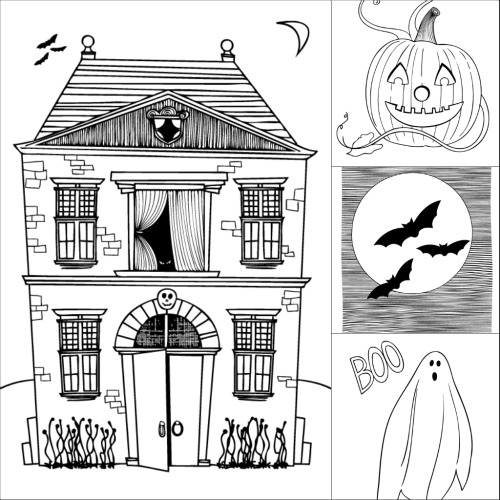
Halloween Coloring Pages: Very simple and kids always love to color. You can find these free in many places. Try the ones at Makes and Takes here.  


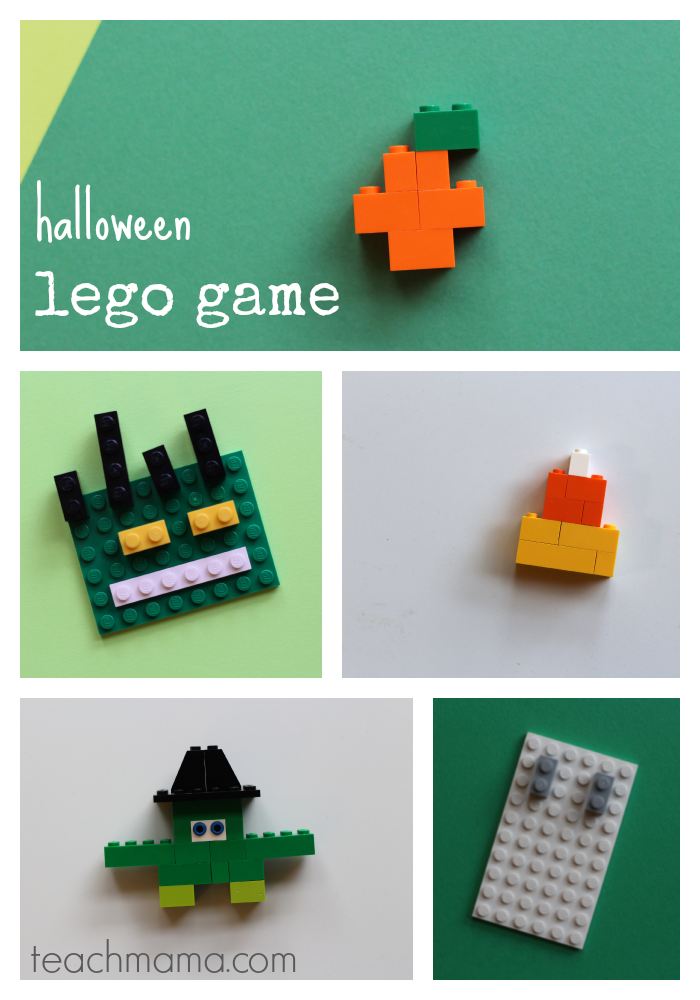
 Halloween Lego Game! It's pretty much like it sounds. Please check out this post from Teach Mama for an explanation! 
Halloween Party Science Station:  Cool experiment ideas including Ghostly Goo, 
Magic Pumpkin Potion and more. Check the full list of ideas here at One Perfect Party.


Gross Halloween Food: Try things like peeled grapes for eyeballs, whole wheat spaghetti for "worms", and cranberry juice for a "vampire drink".

Witches Brew with Dry Ice: Looks really authentic. One of my room moms did it once for our Party and it was awesome. Check out a tutorial at Sandra Lee's site here. (but you ought to leave off the optional alcohol in the recipe!) 

Halloween Witch Pitch: looks kind of like cornhole but with those little erasers and tiny cauldrons. I only found an image but it looks easy to set up and fun! 


What's your favorite Halloween party activity for the classroom? Comment and let us know!

Monday, October 26, 2015

5 Ways to keep it fresh in class!


Is it possible that students could retain more information if teaching was brought up a level, with some incorporated ad-lib and ingenious strategies? Absolutely! Teachers provide a strong foundation for their students and they work tirelessly to ensure each child will flourish under their supervision.  With a few simple ideas, you can transform your classroom into a fresh and creative learning environment where students will thrive.


                             1.   Dress it Up
For instance, you’re teaching an important history lesson, such as Columbus discovering America.  Instead of breaking out the old textbook, and reading aloud together, why not have your students act out history by integrating costumes and accessories to your lesson. In addition, enhance the animation by altering your voice to portray the character you are representing.  Another clever idea for teachers is to engage his/her students by accessorizing in conjunction to a theme of a book. This technique will not only increase participation, but will also insure a higher level of memory retention which leads to better scores.


        2.    Make a Rap or Song

As some of you may recall, back in the day there was “School House Rock”.  These catchy jingles were a collection of learning tools that incorporated every subject from English to history.  Hundreds of kids memorized these Saturday morning songs, unaware that they were retaining information while essentially entertained by the lyrics.   As of today, they still can be found on the internet and are utilized as a valid approach to learning.  Furthermore, with the help of your students, creating unique songs or raps will introduce an otherwise uneventful topic and replace it with a dramatic approach.  It’s not only fun, but will also inspire your students in a positive way.  Don’t be surprised if you ask one to recite the alphabet or a sampling of verbs and they begin singing the words.


3.    Engage Students
Sometimes, it’s beneficial to allow students to contribute to a portion of the teaching.  It encourages the child to build required confidence and knowledge retention of subjects they are explaining.  Not every student is an expert; however, they all can participate in an important role in the teaching process.  Assign individual tasks to your students, such as a chapter or internet research, and then have them deliver what they learned to their peers.  Engaging children to be involved is an ideal way to keep their attention on the subject at hand, plus contributes to their empowerment to be successful.


                                     4.    Change it Up
When you develop a routine, you’re aware of what to expect.  There isn’t any guessing, it’s the same circumstance every day.  Same is boring and uneventful.  Keep your students wondering what the day will offer by altering the routine. Present your schedule backwards, sideways, or however way to change up the daily monotony.  Even changing up the scenery, such as seating arrangements similar to musical chairs or a class mascot that alternates position on a daily basis can refresh the classroom environment.  Above all, be different, be creative, and never let your class become a generic entourage.


       5.    Food For Thought
Have you ever heard of one student that didn’t like food?  By incorporating food into a lesson, you’re satisfying both their bottomless pits and your desire for them to learn.  Food or snacks can be used for various subjects, whether it be teaching fractions from a pie or pizza, or introducing an ethnic snack for a history lesson.  Even allowing students to participate by bringing a certain genre of cuisine to class can be enlightening.  If your lesson is on Mexico, have each student bring in something simple that generates from that heritage.  This can be ideal for a once a month treat, or an end of the week class get together for a job well done.


In conclusion, these 5 uncomplicated ways of keeping it fresh in the classroom will not only enhance a student’s learning ability, but will also create an excitement for education.  Stale is the opposite of fresh, it’s something you might get in bread; however, it should never be seen in the classroom.  So keep it entertaining, adventurous, and creative; after all, learning should be fun, not a stagnant gathering of knowledge.


Friday, October 23, 2015

Day of the Dead Altars

     Our class will be learning about Day of the Dead on the Week of October 26 – 30, 2015. That week, students will have the choice of either completing their weekly homework packet or putting together a Day of the Dead altar. I give them the option just in case they do not celebrate this or any other holiday. 
     

     Day of the Dead is a Mexican celebration. Although it is celebrated in many Latin American countries and cities with Spanish speaking communities, it originated in Mexico.
     Day of the Dead celebrates the life of the dead with foods, drinks, celebrations, and activities that the dead enjoyed during their lives. 
     During Day of the Dead, families decorate an altar. The altar is decorated with many objects and/or special artifacts. These objects or artifacts remember the person being honored.    


     An altar contains photographs of the deceased that is being remembered. Next to the photo, they place their favorite foods and decorate with papel picado. They also include candles, marigold flowers, pan de muerto, sugar skulls, and skeletons.
     Your students can also take part in this beautiful Latin American tradition while creating their very own Day of the Dead, shoe box altar to remember a dearly departed family member, friend, or pet.
     The purpose of this activity is so that your students can talk to their families and learn about their ancestors.

**All of these altars were created by my 2nd grade students from last year.**
----------------------------------------------------------
Remind your students that:

An altar is a space used to place all the wonderful things that remind you of those who have passed. It consists of pictures, candles, flowers, treats, and of course yummy foods. They are considered offerings to the dead who come to visit us on this one magical day.

To make your own Day of the Dead Shoebox Altar you need:
–Shoe-box of any size
–Paper or wrapping paper to cover your box
–Pictures of passed loved ones
–Items loved ones enjoyed -remember anything counts as an offering
–Candle (LED please)
–Tissue for flowers- optional, but flowers play a big part in the decor of an altar. You can also use fake flowers.

To build your altar:
1- Wrap you box in paper. It’s nice to use bright colors perhaps even colors your loved ones liked.
2-Place your pictures. It’s best to adhere them to the inside wall of the box. We used Popsicle sticks to create frames. It was a nice touch to decorate.
3. Place any other decor. We used wooden crosses, religious saint pictures and lots of hearts and gems.
4. Add other treats and foods. Anything from chocolates to chips to real food.


5. Lastly add some non-lit candles and make some tissue paper flores, flowers.
I hope you and your students enjoy this fun activity. 


Tuesday, October 20, 2015

Easy Prep Math Stations {The Learning Chambers}


I absolutely LOVE October!  I love the cooler weather ... well here in Texas it's in the 80s ... and I love how the students know the routine of our classroom.  Some things still need a little work, but for the most part, we have a wonderful routine.

Today I wanted to share a few of my go-to simple math stations for my second graders.  They can be easily differentiated for your students and the best part is that they are low prep.

#1 - Velcro Number Line
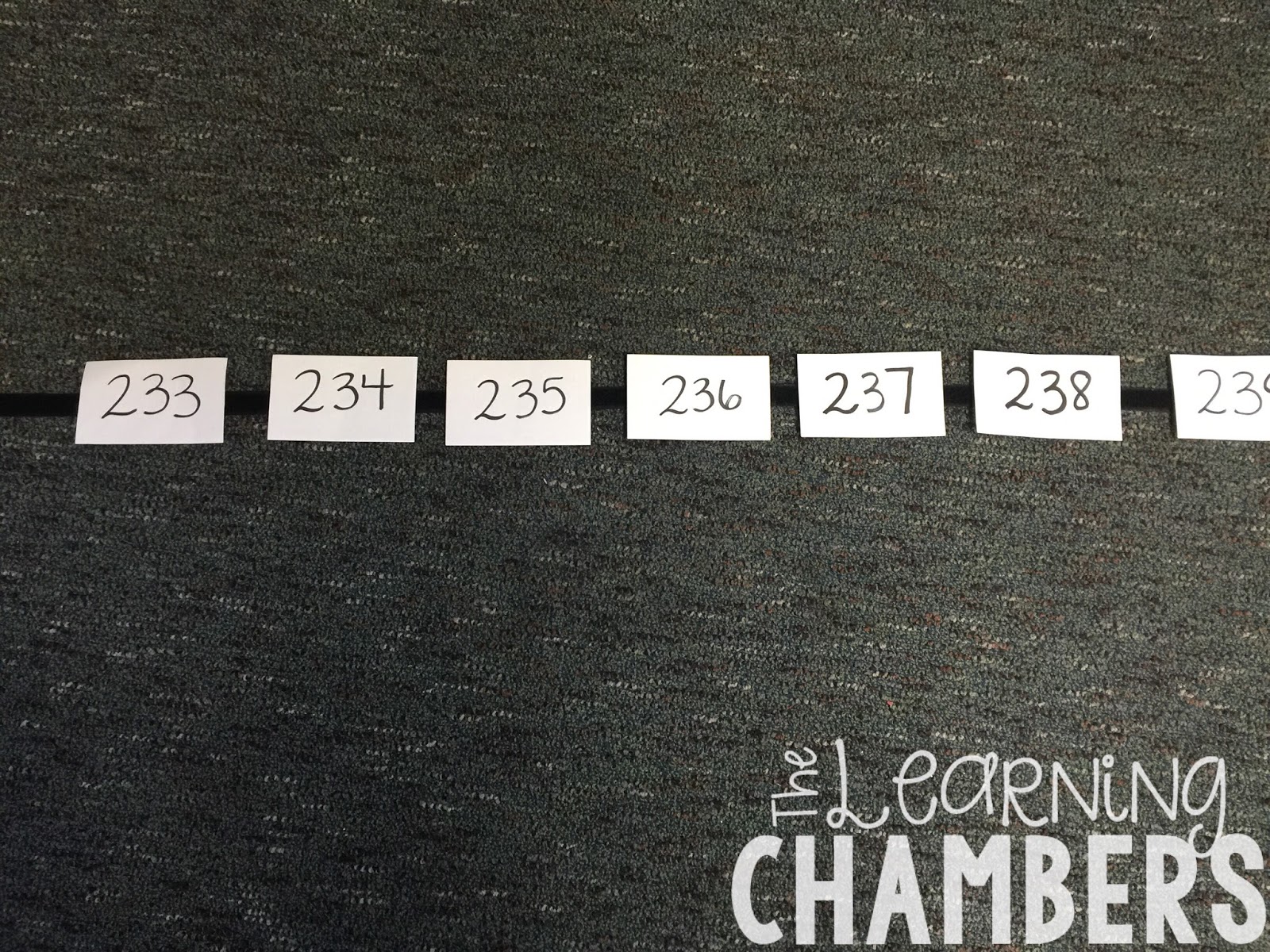
I don't know what it is about number lines, but my students always seem to struggle with ordering numbers on an open number line.  I wanted to create an easy to use giant number line for my students to work with.  One day when I picked up my kiddos from music class, I noticed that the music teacher had a giant music staff on her carpet.  I totally had to ask how she did it!  To my surprise, she had just used two strips of sticky back velcro and stuck both of the strips together.


Then, she velcroed the clingy part to the carpet.  It sticks to the carpet perfectly y'all ... and it's easily moved to another spot in the room!  No sticky residue left behind either!  Genius!!


Then, I wrote numbers on index cards and placed a small strip of velcro to the back of each card.  The kids take the cards and order them as part of a station.  I also have cards with question marks to have them identify the missing numbers on an open number line.  To differentiate, I have a variety of numbers for the students to choose from.  They can work with 1-digit, 2-digit, or 3-digit numbers.

#2 - UNO Cards for Greater Than and Less Than


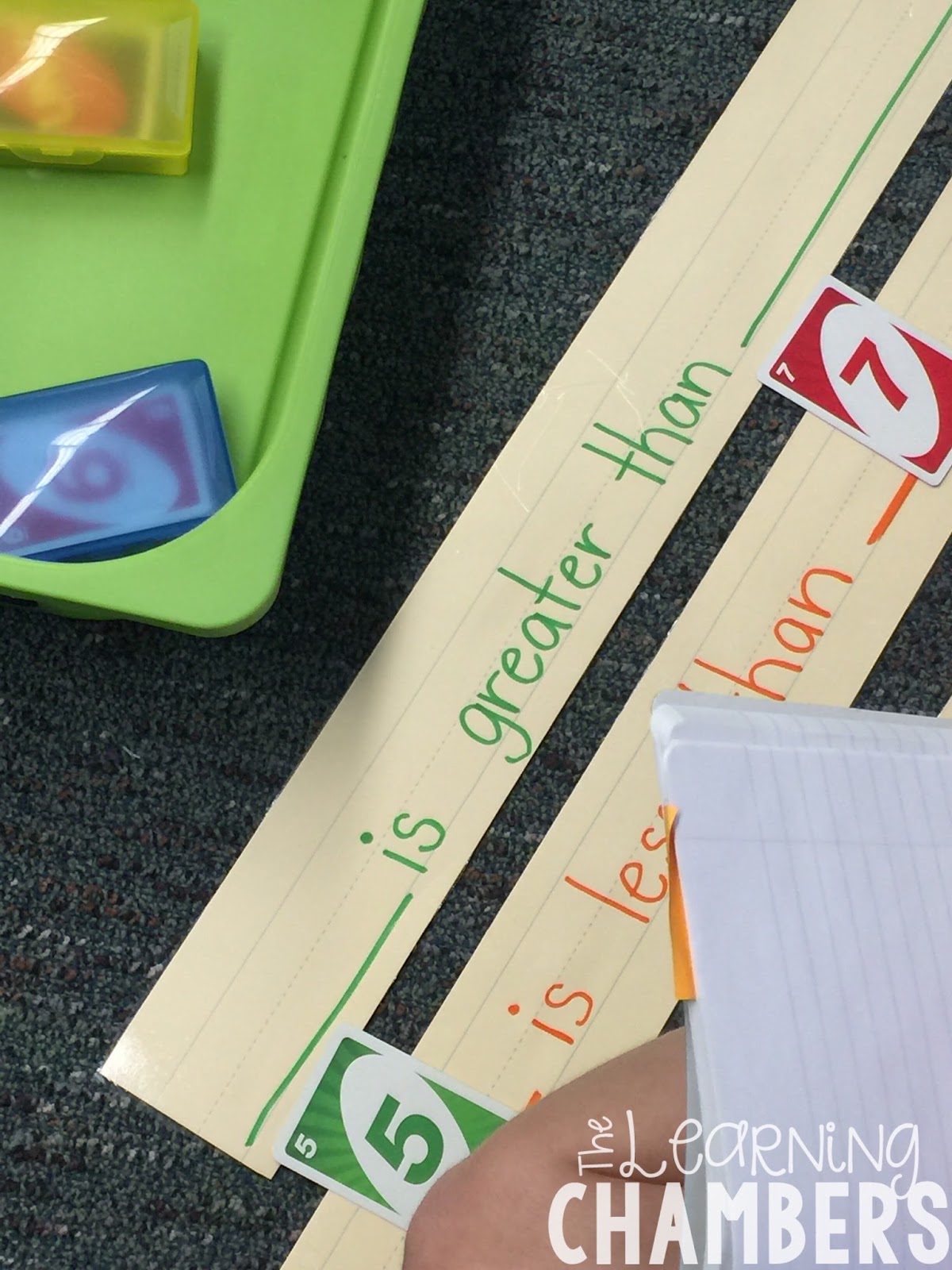
I love using sentence strip stations because they are easily differentiated.  My students can choose to also use 2-digit and 3-digit numbers by building them with the Uno Cards.  They play with a partner and one partner draws the first card and then the second partner draws the second card.  They record their work in their math workstation journal and I do random quick checks through the week, to make sure they are completing their work.  I also have sentence strips with just the > and < symbols.


#3 - Roll and Show Place Value Game


Roll and Show is another math partner game that can be easily differentiated.  I also have another dice in the station, so that the kids can build 3-digit numbers.  The kids roll the dice and then build the number using the base ten blocks.  They record the number in their journal in standard form, word form, and expanded form.  Super simple but great practice for a hard math concept.

I hope you enjoyed these 3 super simple easy prep math stations!  I would love to hear how they work in your class.  You can click on my button below to check out my blog for more Math, LA, and tech ideas.


Monday, October 19, 2015

Digital Reports with an App

Hi, teacher friends.  It's Peggy Means from Primary Flourish to share with you a powerful little app that will motivate your students to research and write a report about almost anything!
Sonic Pics is a digital story telling app.  
Students add their pictures, 
add text
narrate
Tada!  They have made a digital report!

I introduce the project as a movie, and explain that movie makers always start with a storyboard.
Now the storyboard is really the rough draft and it is the key to guide their research and their writing.

The first project my second graders did with this app was a 'documentary' about where they live.
Students used the Google Earth app to research the names of their 
continent, county, state, city, street, and address.  
Then they wrote out the sentence that they would narrate when they were ready to make the 'movie'.

After the storyboard is complete it is time to add add the pictures.  We went back to Google earth and took screenshots of each location.  
Continent
Country
State
Town
Street

When all the pictures have been added, students are ready to add the narration to their 'documentary'.  This is a wonderful opportunity to review reading fluency.

Sonic Pics is very forgiving and allows one to move pictures around, switch pictures, and re-record as many times as students want.  It can then be shared in a variety of ways; mail, photos, YouTube, and even Google Drive.

I am sure that once you and your students start playing with this app, you will think of dozens of ways to use it in your curriculum.

Here are some additional 'Story Boards' we have used for other topics of study:

I especially love this one, because it provides the 
framework for a well-constructed paragraph. 


Click on the picture to see Sonic Pics
in the App Store.


I would love to hear ways you are planning on using Sonic Pics with your students!
Primary Flourish