Showing posts with label freebie. Show all posts

Wednesday, November 18, 2015

Let's Talk Turkey - Fictional Turkey Fun!

Happy Wednesday, folks! It's Lisa from over at Second Grade Stories. Are you looking for some last minute fictional turkey fun for your kiddos this week or next? I want to share some of my favorite books to use each year with our turkey theme. I also created a quick freebie you can use with each book, just to keep things easy for you!


I LOVE this book, and so do my kiddos. It's the perfect book to read if do a "disguise a turkey" project. (Check out THIS POST from Melissa over at Mrs. Dailey's Classroom if you're looking for some disguise inspiration!) The turkey's costumes are funny and second graders really get the humor in this book. I like to go back and reread the book closely, looking for the things the animals say that relate to what costume the turkey is wearing. The story structure lends itself well to a problem/attempts/solution structure. I created a simple retelling sheet, as well as a response sheet for students to come up with their own costumes for turkey. This is an easy alternative to a big turkey disguise project.


These next books go together - I have two of them, but I didn't know there was a third! The Great Turkey Race tells about how the turkeys save themselves from being eaten on Thanksgiving  and how they decide to be good friends and save another turkey who hasn't been so nice! In The Amazing Turkey Rescue, the turkeys are back at the farm working to save their friends the chickens from the mean fox that has showed up. These are both great books to use for character traits, as well as story structure and problem/solution. I created some discussion cards you use to have your kiddos turn and talk - or with a small group - to talk about the stories. I also like to compare and contrast the two stories, as well.


My final favorite book is not about turkeys - but about being thankful. It lends itself to a wonderful writing project. In the book, the daughter looks through her mother's scrapbook, asking about all the wonderful things she has done, and asking which is her "most thankful thing?" Of course, the Mom's most thankful things is her daughter, which brings the story to a wonderful ending. At the start of our writing activity, I ask my students to list some of their most thankful moments. Then we go through the list and talk about each one. This not only helps us be ready to choose our MOST thankful moment, but the oral discussion helps students be able to add details to their ideas when we start our writing. After everyone has one most thankful thing, we start our writing. We use a topic sentence, some details and have a great writing activity that not only shows what we are thankful for, but also helps me to get to know my students a little better, too.

 You can grab all this turkey fun in one place, by clicking {HERE}.  And you can head over to my blog and see what I've got planned for some informational turkey reading and writing! Happy Thanksgiving!


Monday, October 12, 2015

Forms of Energy {Light, Heat, & Sound}


I don't know about you, but sometimes something that seems like it would be so easy to teach seems a little daunting.  How can I make science fun and hands on?  How can I make this a meaningful learning experience for my students?  How can I make a lesson where the kids don't get out of control?  Anyone feel me?!  That is how I felt about teaching forces of energy.  I knew this could be a super fun unit, and that is just what we made it...FUN!  It is especially fun when you have lots of hands on things for the kids to do!  For this unit, we tried to incorporate some exciting experiments for the kids so that there was a lot of "self-discovery" going on.

We opened up the unit by learning about light.  We had shoe boxes with a few "mystery" items inside.  We requested shoe box donations from parents in advance (we got way more than we needed)!  We also had the kids bring in a small flashlight.  It was okay if not every child brought one in because they were working in groups!  So, no one felt left out if they forgot their flashlight!  The kids began by looking in their shoe boxes without a flashlight.  We questioned them as they looked inside.  "Wow, look at all of those mystery objects!  I bet you can see them so well!"  Then, a roar from the crowd, "I can't see anything!"  Then, we broke out the flashlights!  The kids looked through the little hole on the top of the shoe box and discovered that they could see a little more.  Then, they looked through a larger hole on the side and discovered that they could see the mystery objects much better.  While they were working, they wrote down what they thought the items were.  Finally, we opened up the boxes and looked at the mystery items up close!   

The next week, we went to the science lab and did some hands on rotations about items that produce heat.  The students had a lot of fun.  It was perfect!  Before we went, we discussed expectations like not putting our hand directly in front of the hairdryer.  We also talked about what it means for items to produce their own heat.  As the kids moved from station to station, they recorded if the item produced its own heat and they drew it!  This was a good grade too!

The day after that, the kids had a blast doing the M & M experiment where they held one in a closed hand, held one in an open hand, and laid one on their desk. Then, the kids waited 5 minutes with their hand closed to see what happened. After 5 minutes, they open up their hand and recorded what happened!

The third week of learning about energy, we made a "sound wave."  We prefaced this by watching this short video on how to create the sound wave. I thought this might be a little difficult, but the kids LOVED it, and it was not hard at all!!                                                                                                      They thought it was so cool, and all of the students got involved!  We demonstrated how sound waves move and echoes happen.  Then, we watched a video that I found on You Tube about sound.   I teach second grade and I was hoping it was not too "babyish" for them.  It was not!  They liked it a lot! 

We also discussed pitch by doing the glasses of water activity and making a straw flute!  I have included the recording sheet for the glasses activity in my Energy Forces set, but we did it in our science journals.


During this unit, we also made an anchor chart and the students recorded this information in their science notebooks.  We did a few sorts and then ended the unit with a fun Kahoot, review to send home, and an energy test!

Click the picture above for a FREEBIE!

This was definitely a unit that the kids will remember and that we will do again next year!  Find all of these great experiments, directions, printables, and worksheets in my TPT store within my Forms of Energy Unit!  If you have some fun ideas for teaching energy, please comment below!


Wednesday, September 30, 2015

What Your Teacher's Guide Won't Tell You About Comprehension

What your teacher's guide won't tell you about comprehension, one simple way to organize the strategies and termsHi there!  It's Hannah from The Classroom Key.   Do you ever feel like your kids are drowning in all the reading strategies and terms you have taught them?  When you ask for the main idea of a text, do they just give you a one word answer?  Or do they launch into a full summary?


One of the first reading strategies I teach is finding the main idea.  Then later we also talk about summarizing... and along with summarizing comes identifying story elements... and some assessments ask students to identify the topic of a text... and on, and on!  Geeze, my head is spinning already!

What your reading series teacher's guide (if you even have one!) won't tell you, is that kids need a way to organize those strategies and terms in their heads!  It may be that your students are good comprehenders but they're getting lost in the terminology.  This can be especially problematic on assessments when you can't prompt them for less or more information. 

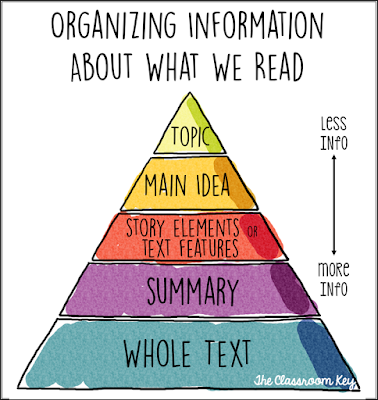
Enter: a solution!  This chart shows how some of the most common reading comprehension terms and strategies relate to one another.  

Reading Comprehension Pyramid, help students see how common reading terms and strategies relate to one another

Notice the bottom of the pyramid is the whole text.  This is the maximum amount of information.  Next is a summary which offers a little less information.  Up higher is the major story elements (characters, setting, problem, and solution) or content from text features (for nonfiction) which is less information still.  Then comes the main idea which is probably just a sentence or two.  Finally at the very top is the topic which would only be one or two words.  

If you ask your students to identify the main idea and they start launching into a summary, draw their attention to this chart to define the difference.  Conversely, if you ask for the main idea of a text and a student says "owls," you can point out how a one word answer would be the topic, but a main idea statement gives a little bit more information.  

Click the picture to download the chart and also a black and white version you can copy for students! 

Thanks for stopping by!


Hannah


Clip art in this post comes from the talented Sarah Pecorino.


Friday, September 25, 2015

Freebie Friday - Try Out Some Interactive Notebook Activities

Freebie Friday - Try Out Some Interactive Notebook Activities 

Hey everyone! I'm Bex from Reading and Writing Redhead. I don't know about you but I  have been so overwhelmed with the first few weeks of school! I finally feel like the routines are pretty set with students and they understand expectations and we have built a classroom community. So I have started working in our interactive notebooks. I thought I would stop by and share a freebie if you'd like to try some math interactive notebook activities with your second graders. The topic is money and to grab them, simply click HERE or on the image at the bottom of the post! If you do, and have a few seconds, I sure would appreciate feedback on what you think. And who knows, maybe after your class tries these activities, they will be as excited as this girl!

Freebie Friday - Try Out Some Interactive Notebook Activities


Freebie Friday - Try Out Some Interactive Notebook Activities 


Tuesday, September 15, 2015

2 Tips to Tame the Morning Chaos

Hi, teacher friends.  It's Peggy Means from Primary Flourish with some tips to help you and your students 'flourish' with a morning routine.
Classroom Management


Don't you just love this picture?!
Look at their enthusiasm ...
... their determination ...
... their speed ...
... their joy ...
all coming into YOUR classroom!

After years of frustration with the chaos of my mornings with the students,
I found 2 routines that tamed - not squelched - tamed and directed ...
... their determination ...
... their speed ...
... their joy ...
as they come into YOUR classroom!
I call it "Rise & Shine" because that's what I want the students to do...
rise to the challenges of the day ...
and shine with their best!

It is PowerPoint slide that you project every morning as the students arrive.  They can quickly see what they need to do to prepare for the day - and you have a few moments to take roll, lunch count, or any other morning responsibilities that you may have.
This really transformed my mornings!  Now the students were self-directed and productive!
And it was a snap for me to create every day - much easier - and cuter - than writing it on the whiteboard every day.

If you would like to give this a try - 
you can download it - 
for free!
I made the slides editable so you can add what you need to for each new day!
I think it will make your mornings so much easier!
Morning Routines

There is just something wonderful about music and the effect it has on us!
I found that music playing as the students enter the classroom helps them 
transition and refocus their attention!
I have a morning playlist with a variety of tempos:
Quiet music on Mondays when their energy is high.
Lively music for the Fridays (and the day after a field trip).
Variety of tempos in between.

I hope these 2 tips will help you 'tame the morning chaos'!

Primary Flourish


Saturday, September 12, 2015

Tips to Challenge High Achievers in Math

 
Hi everyone!  It’s Susan Morrow from the Keep ‘em Thinking blog. As a gifted coordinator, one of my responsibilities is to help general education teachers differentiate for high achievers in their classroom, so today I’m going to share with you some tried and true activities to help you meet the needs of high achievers in math. 
 
 Our role is to prepare our students to be critical thinkers and problem solvers.  Too many times we’re too focused on the content at the expense of the thinking.  For example, many teachers think that students in second grade who already know their addition and subtraction facts are ready to move on to multiplication.  While I feel subject acceleration is appropriate for some students, I believe it is more important to increase the depth and complexity of the grade level content rather than teach above grade level content. 
 
By depth and complexity, I mean to increase the intellectual demand.   Provide opportunities for your students to apply what they have learned in situations that require them to analyze, evaluate, and create.  

Okay, enough of the soapbox.  What does increasing intellectual demand actually look like in a classroom?  Let’s say you have a group of students who have already mastered their addition and subtraction facts.  What can you do?  Let’s have them use some algebraic reasoning! Give them addition problems with missing addends, minuends, and/or subtrahends and have them figure out their value.  Once they have mastered that, have them create their own problems.  Here is an example of some task cards I created that are great for second graders at the beginning of the year:
 
These cards really require the kiddos to think and analyze.  You don't have to use cards like these.  You can make your own and substitute geometric shapes for the clip art.
 
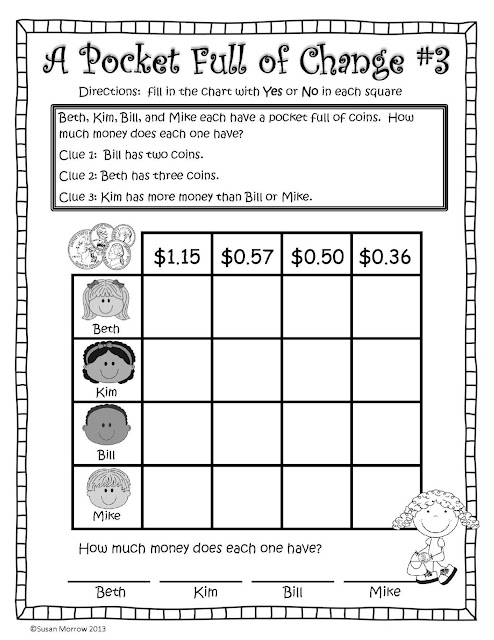
If you’re teaching money, how about having the students complete some logic puzzles using money?  This is an example of a money logic puzzle I created for second graders.  These logic puzzles require the kiddos to analyze and use deductive reasoning to figure out the solution.  You can download a free set of money logic puzzles by clicking on the picture OR here:  MONEY LOGIC PUZZLES
https://drive.google.com/open?id=0B__eI6Wa4tFCSmJ2S3ZNU3drQzQ

Another activity I created for second graders was mystery money puzzlers.  Students are given clues to the amount of money in a pocket, and they have to figure out the amount.  They are a great activity to place in a math center.  My kiddoes LOVED this activity so much that they took them home for their parents to do.  I knew this activity was a hit when some of the kiddos started creating their own puzzles. 


Kids love math riddles.  You don't have to use them just for money.  Here is an example of some math riddles I have used successfully with my students:

 
1.   I am a 2-digit number.  You say my name when you count by 2’s, 3’s, and 4’s.  The sum of my numbers is 12.  What number am I?  48
2.  I am a 2- digit number.  You say my name when you count by 2’s and 4’s.  The difference of my numbers is 1.  What number am I?  32
 
Give your high achievers word problems and multiple step problems.  They are learning the same content and skills, but you just increased the intellectual demand.  I also love to have my kiddos write mathematical fairy tales.   It is a wonderful opportunity to integrate writing into the math curriculum.  Here is an example of a fairy tale using money which was written by one of my second graders. 

Lastly,  I want to share with you a fun activity you can use with your kiddos. Have the student select a beginning number and an ending number.  They then use ten steps with addition and subtraction to get to the target number.  Here is an example of the challenge:


Here is how one student completed the challenge. 
 
 
What I love about this activity is that there is no one right answer!  There are so many different way to complete the task.  I think that is especially good with math because most of our kiddos think there should be one right answer to any problem.

Our high achievers often make straight A’s with little or no effort.  If we want to teach them the relationship between effort and achievement, we must provide them with challenging learning experiences.  High achievers get excited with challenge, but if the work is too easy or something they can master quickly, they become bored, develop poor study habits, and can be discipline problems. 

I hope you find these activities beneficial and incorporate a few into your math curriculum this year.  Next month I plan to give you some great ideas to differentiate for high achievers in language arts.  Until next time, remember to always Keep ‘em Thinking!


Monday, July 27, 2015

Back to School FREEBIE

Hi there!  It's Hannah from The Classroom Key!


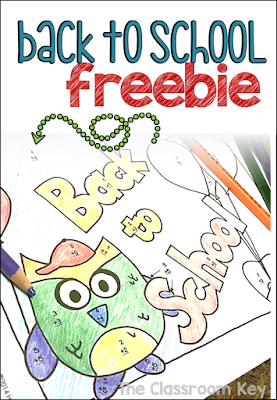
For Make it Monday I've got a cute back to school freebie for your students to make.  This color by number is perfect for second graders because they have to solve doubles problems within 10.  I know I like to help them dust off those math facts when they come back after the summer.

back to school FREEBIE


This is a great fill in activity when you don't have all of your routines up and running.  It's also a good opportunity to set an expectation for neatness in 2nd grade work.  How about putting it out for kids to do while you talk to their parents at back to school night?  Lots of possibilities!   Click the picture to grab a copy!

Best of luck in the coming school year!

Hannah